

Gi vs.
No-Gi BJJ
Demystifying the two training tracks so beginners can step onto the mats with total confidence, and know exactly where to start.
If you are new to Brazilian Jiu-Jitsu, one of the first questions you will run into is Gi or No-Gi. Both are legitimate, both are taught here in Ville Saint-Laurent, and neither is better than the other, they simply develop different skills. Here is exactly what separates them, and where most beginners should actually start.

What Is Gi Jiu-Jitsu?
Gi Jiu-Jitsu is trained in the traditional cotton kimono, or "gi," along with a belt that marks rank. The gi's collar, sleeves, and pant legs become tools: you can grip them to control distance, off-balance an opponent, or set up chokes and joint locks that would not exist without fabric to grab.
Because grips slow the pace down, Gi training tends to reward patience, technical precision, and position before submission thinking. It is also the format most schools, including ours, use to teach fundamentals, since the grips make each technique easier to see, feel, and repeat correctly.
What Is No-Gi Jiu-Jitsu?
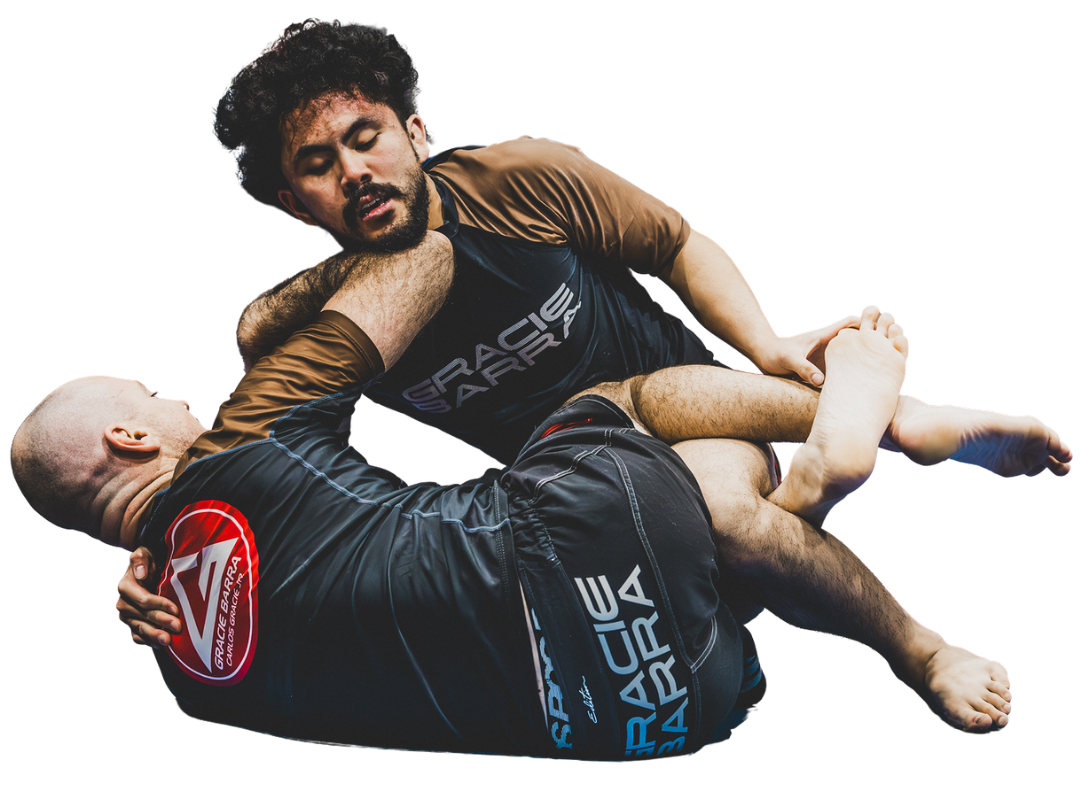
No-Gi Jiu-Jitsu is trained in a rashguard and shorts, with no jacket to grip. Without fabric to hold onto, control comes from underhooks, overhooks, wrist and ankle control, and body positioning instead.
The pace is usually faster and sweatier, since there is less to slow an opponent down once they start moving. Many of the takedowns and scrambles you see in MMA and modern grappling competitions are trained No-Gi, which is why it has become the default format for a lot of high-level competition.
Key Differences at a Glance
Gi (Kimono) Training
Grips on the collar, sleeves, and pants open up chokes and control positions that do not exist without the jacket.
Generally a slower, more technical pace built around position before submission.
How every new student starts, through our GB1 Fundamentals program.
No-Gi Training
No jacket to grip, so control comes from underhooks, wrist control, and body positioning instead.
Faster, more scramble-heavy pace, closer to what you see in MMA and modern grappling competitions.
Introduced in our GB2 Advanced program, alongside live sparring.
Where Should Beginners Start?
At Gracie Barra Saint-Laurent, every new student starts in Gi through our GB1 Fundamentals program, regardless of whether No-Gi is the eventual goal. The grips give you something concrete to hold onto, literally, while you are still learning the basic positions, escapes, and submissions that everything else in BJJ is built on.
Once you have a handful of stripes and a few months of consistent training, you become eligible for GB2, where No-Gi training and live sparring are introduced. By that point the fundamentals transfer over quickly, since the underlying concepts of control and leverage are the same, only the grips change.
If your only goal is competition or self-defense without ever touching a gi, that is a conversation worth having with one of our instructors directly. Most students, though, find that starting in Gi actually makes their No-Gi game stronger once they get there.
You do not have to choose between Gi and No-Gi when you start. You just have to start. Everything after that sorts itself out on the mats.
Gracie Barra Saint-Laurent Coaching TeamGi and No-Gi at Gracie Barra Saint-Laurent
Our program structure is built around this progression. GB1 Fundamentals teaches the foundational Gi curriculum every student needs. GB2 Advanced introduces No-Gi training and live sparring once you have enough reps under your belt. GB3 Experts trains at an elite level in both Gi and No-Gi formats, for students preparing to compete or simply looking for the highest level of training available.
Whichever format ends up being your favorite, both are taught by the same certified instructors, on the same mats, at the same academy in Ville Saint-Laurent.
| GB1 Fundamentals | Gi only |
| GB2 Advanced | Gi and No-Gi, with live sparring |
| GB3 Experts | Gi and No-Gi, competition-focused |
Frequently asked questions
Should beginners start with Gi or No-Gi BJJ?
Beginners should start with Gi. At Gracie Barra Saint-Laurent, every new student begins in the GB1 Fundamentals program, which is taught in the Gi, before progressing to No-Gi training in GB2.
Do I need to buy a gi before my first class?
No. Your free trial class is casual, comfortable clothing is fine. If you continue training, we help you get properly fitted for a gi as part of joining the academy.
Is No-Gi BJJ harder than Gi BJJ?
They are different, not harder or easier. No-Gi tends to move faster since there are no grips to slow an opponent down, while Gi rewards patience and precise control. Most students find each style makes them better at the other.
Can I only train No-Gi and skip the Gi entirely?
It is possible to focus on No-Gi long-term, but new students at Gracie Barra Saint-Laurent start in Gi through GB1, since the grips make positions and submissions easier to learn correctly before removing them.
What do I wear for No-Gi training?
A rashguard and grappling shorts or spats. No kimono is required for No-Gi classes.
Explore more
No experience needed. No contract required. Just show up and see what BJJ can do for you.
Book Your Free Trial Class Or call us directly at 514-243-5455